
Illuminating the Sales Dark Funnel to Capture Revenue Before the First Click
As leaders responsible for sustainable revenue growth, we face a fundamental shift in buyer behaviour. Buyers are more informed, more cautious, and far more independent than ever before. This white paper offers a thought leadership perspective on the “dark funnel” – the largely invisible portion of the buyer’s journey – and why mastering it has become the defining competitive advantage for forward-thinking organisations.
The End of the Linear Funnel Illusion
For decades, we built strategies around a comforting linear model: attract attention with advertising, nurture through content, capture intent with a form submission, and hand the lead to sales. It was predictable, measurable, and reassuring.
Yet this model is now a myth. Research consistently shows that 70-90% of the B2B buyer’s journey is completed anonymously before any direct engagement with a vendor. By the time a prospect raises their hand through a form fill, they have already researched solutions, consulted peers, built a shortlist, and often decided on a preferred provider. At that point, we are not leading the conversation – we are merely being invited to submit a quote against the frontrunner.
True revenue leadership today demands that we stop waiting at the end of the funnel and start influencing decisions much earlier, in the shadows where real evaluation happens.
Understanding the True Shape of Modern Buying
Beneath the visible tip captured in most CRMs lies the dark funnel: private Slack channels, WhatsApp groups, Reddit discussions, peer recommendations shared in direct messages, and untracked review site visits. These are the spaces where reputations are built, doubts are raised, and preferences are formed.
A significant portion of what appears as “direct traffic” in analytics is in fact dark social – content shared privately beyond the reach of standard tracking pixels. When organisations continue to make multimillion-pound decisions based on this partial view, they are effectively flying blind.
The organisations that will win in the coming years are those that acknowledge this reality and build capability to gain ethical, actionable visibility into these hidden signals.
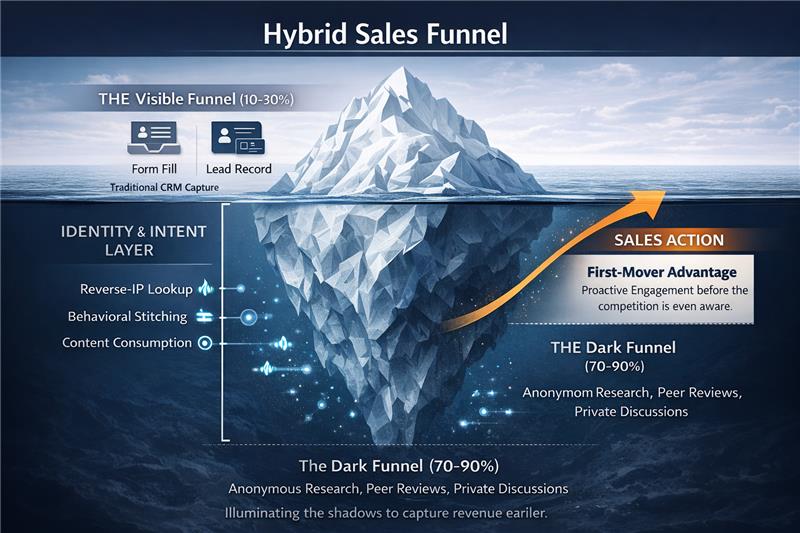
Most companies are fighting over the 10% of the iceberg they can see. At Tatva, we give you the sonar to see the 90% below the surface. That is where the deal is actually won
Turning Anonymous Signals into Strategic Advantage
Identity Resolution: From Shadows to Clarity
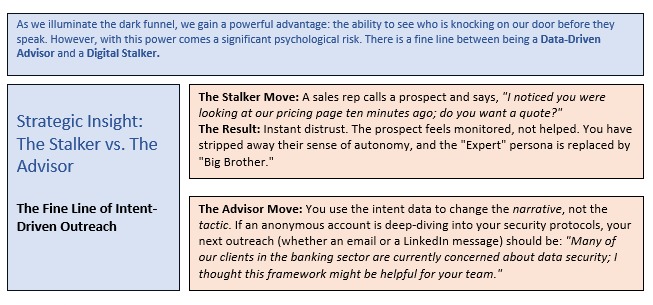
Basic website metrics tell us little beyond “someone visited.” Progressive leaders recognise that linking anonymous activity to specific accounts – through reverse IP lookup and behavioural pattern matching – provides critical context. Discovering that a major target account has repeatedly viewed pricing or integration pages creates an opportunity to engage meaningfully while intent is still forming.
Behavioural Intelligence: The New Currency of Prioritisation
We have long overvalued demographic signals such as job title. Experience shows that a chief executive’s fleeting visit is far less predictive than a senior manager’s deep dive into technical documentation. Behavioural signals – depth of engagement, content consumed, repeat visits – prove ten times more reliable in forecasting revenue potential. Leaders who reorient scoring models around actions rather than titles consistently achieve higher conversion rates and better resource allocation.
Predictive, Intent-Driven Outreach: Leading Rather Than Chasing
Timing remains the silent killer of deals. Traditional outreach often resembles scattergun activity because it lacks genuine intent data. When organisations harness dark funnel signals to detect research surges, they can initiate contact at the moment of peak receptiveness. The result is outreach that feels timely and valuable rather than intrusive – transforming cold calls into welcomed conversations and dramatically shortening sales cycles.
Mastering the Complexity of Committee Buying
Modern B2B purchases rarely involve a single decision-maker. Typically, a committee of six to ten stakeholders from functions such as IT, finance, legal, and operations conducts parallel research, much of it anonymous. For every visible champion who completes a form, several “ghost” influencers operate unseen.
Forward-thinking organisations treat content not merely as lead magnets but as detection mechanisms. By selectively ungating (getting approval to sell certain restricted or gated products on a platform) high-value assets while retaining IP-based tracking, leaders gain insight into committee readiness far earlier than traditional methods allow.
Intent signals decay rapidly. A strong morning surge can dissipate by afternoon as attention shifts to competitors. The most successful teams therefore build automated workflows that translate signals into immediate, coordinated action.
Building Sustainable, Scalable Revenue Engines
Too many organisations remain dependent on a handful of star performers who intuitively navigate these complexities. This “hero culture” inhibits growth and creates unacceptable risk.
The next frontier of revenue leadership lies in codifying proven playbooks and embedding them into systems. When an account demonstrates clear buying signals, standardised yet personalised sequences should trigger automatically. This approach elevates performance across the entire team, making excellence repeatable rather than exceptional.
Finally, measurement must evolve beyond last-click attribution. True influence is seen in increased anonymous engagement following campaigns, accelerated velocity through the pipeline, and improved win rates. Leaders who adopt this broader lens gain far greater clarity on what actually drives revenue.
The Legal Frontier
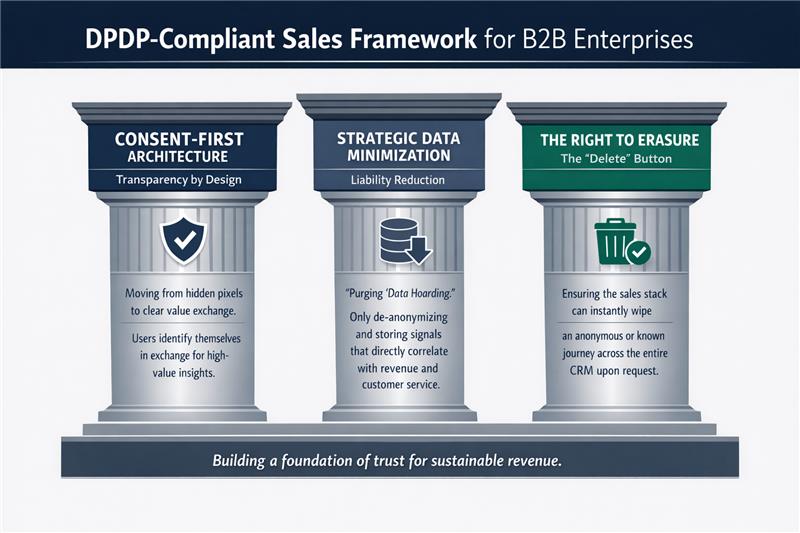
Mastering the Dark Funnel is a competitive necessity, but in the Indian context, it must now be balanced with a new reality: the Digital Personal Data Protection (DPDP) Act. The “Hard Truth” for any CEO is that identifying anonymous intent is no longer just a technical milestone—it is a regulatory touchpoint. If your tracking architecture isn’t built with the same level of legal rigor as your sales strategy, you aren’t just capturing leads; you are accumulating liability.
To turn compliance from a hurdle into a competitive advantage, enterprises must pivot their data strategy around three non-negotiable pillars. These pillars ensure that as we illuminate the shadows of the buyer’s journey, we do so with a foundation of trust and absolute transparency.
Conclusion: Owning the Hidden Journey
The dark funnel is not a problem to fear – it is the remaining arena where genuine competitive differentiation is still possible. Organisations that continue to focus solely on the visible portion of the buyer’s journey will find themselves perpetually reacting rather than shaping outcomes.
Those that invest in ethical illumination of the dark funnel – through advanced identity, behavioural intelligence, predictive orchestration, and scalable automation – will gain first-mover advantage at the earliest and most influential stages of buying.
As revenue leaders, our responsibility is clear: move beyond waiting for form fills and take ownership of the entire journey, from the first anonymous interaction to the final signature. The organisations that embrace this shift today will define the standard for revenue excellence tomorrow.